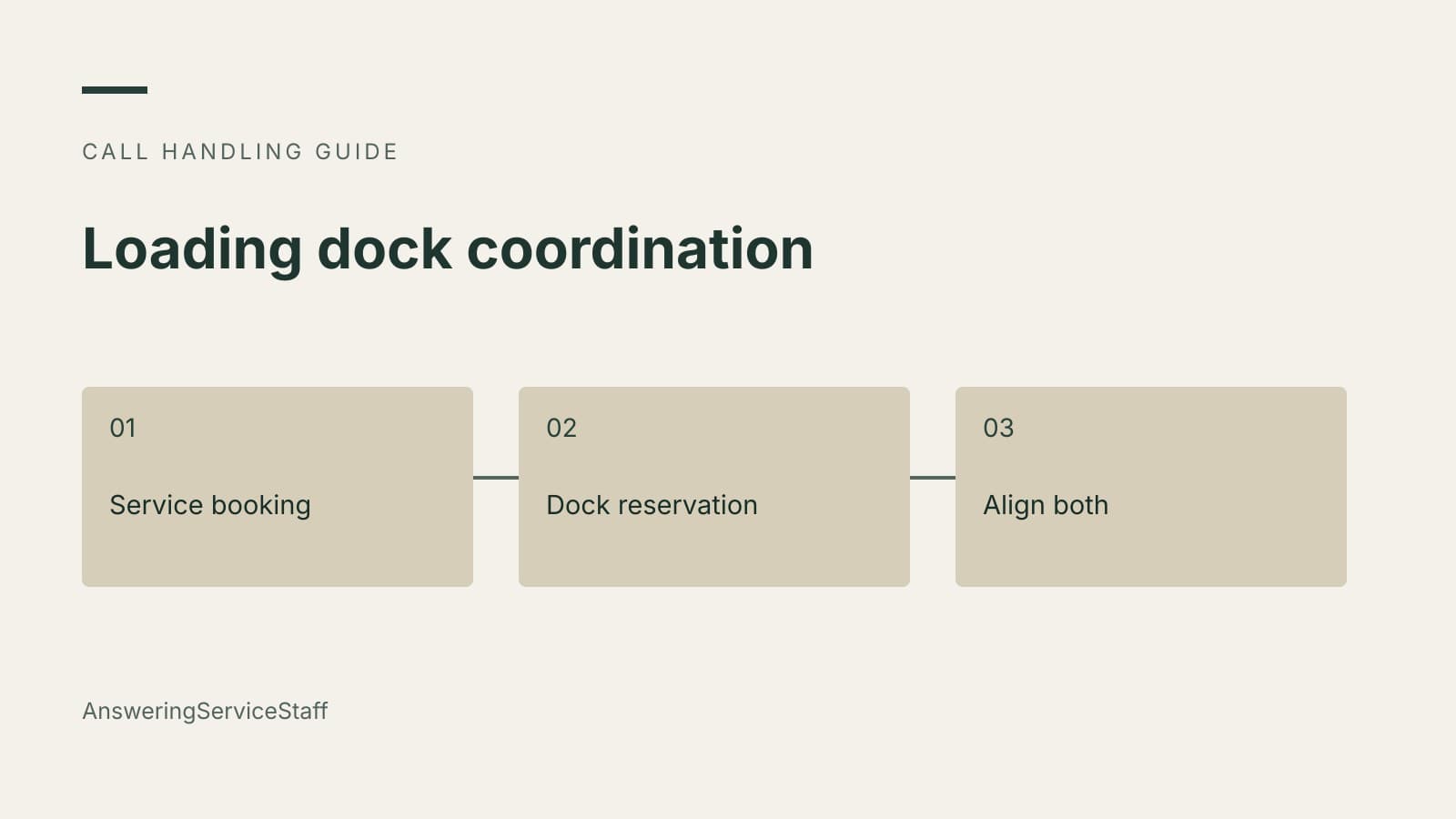
A service appointment and a loading dock reservation can look like one booking to the customer, but they may be controlled by different teams. Confirm both before describing the visit as fully arranged. An available technician does not establish that the building will admit the vehicle at the required time.
This coordination belongs in the rules for appointment booking. The receptionist needs to know who controls the service calendar, who controls building access, and what evidence is required before each reservation can be treated as confirmed.
Identify the two reservations
Ask the caller which service they are arranging and which site the crew will attend. Then ask whether the building requires a separate loading dock slot. Do not assume that ordinary visitor parking and a service loading area follow the same process.
Record the service appointment reference separately from the dock reservation reference. If one has not been issued, mark it as pending. A single free-text field containing a date and time can hide the fact that only one party has agreed.
Also identify who is arranging the dock. It may be the customer, a property manager, or an authorized service coordinator. Reception should not contact a building or make commitments on the customer's behalf unless that is part of the approved role.
Capture the relevant access conditions
Ask for the building's stated booking process and the contact responsible for it. Useful details may include the permitted arrival window, the entrance to use, and whether a vehicle description is required. Record supplied restrictions as building instructions awaiting the service team's review where necessary.
Do not decide whether a vehicle will fit based on an informal description. If the building specifies a clearance or vehicle limit, pass the exact information to the operations owner. That person can compare it with the actual vehicle and equipment.
Avoid collecting access codes in ordinary appointment notes. Use the business's approved secure method if access credentials are needed. The FTC's guide to protecting personal information recommends limiting access to information to people who need it; shared calendar notes should not become a general store of entry credentials.
Align the timing without inventing a buffer
The dock window may cover unloading only, while the service visit lasts longer. Ask the operations owner which timing information reception should use. Do not assume that the entire service must fit inside the dock reservation, or that the crew can remain there after unloading.
Likewise, an arrival window is different from an exact appointment time. If the building accepts vehicles only during a narrow slot, the service owner must determine whether the offered arrival arrangement can meet it. Reception should not turn a broad arrival window into a fixed promise.
A useful comparison has separate entries for expected arrival, dock access, unloading requirements, and the service start. Only use durations or allowances approved by the business. The aim is to expose a mismatch for review, not to solve transport logistics during the call.
An illustrative office installation
Suppose an office customer wants a storage installation on Thursday morning. The service calendar offers a morning arrival window, but the building has offered the dock only from 10:00 to 10:30. Reception records both instead of telling the customer that Thursday is settled.
The installation coordinator checks the crew plan and confirms whether that dock slot is workable. If it is, the customer or authorized coordinator completes the dock reservation and supplies the confirmation reference. The service record then shows that both requirements are confirmed.
If it is not workable, the coordinator identifies approved alternatives. The receptionist can offer those alternatives to the customer without independently changing the dock or service booking. This avoids leaving one reservation active for a visit that the other reservation cannot support.
Make conditional arrangements explicit
Sometimes the business permits a temporary service hold while access is checked. If so, record the hold's expiry and the owner who will resolve it. Explain that the hold is not a fully confirmed visit.
If there is no approved hold process, do not create an unofficial one in a notes field. Route the access question first or follow the business's alternative scheduling rule. A receptionist's reassurance cannot reserve resources that the booking system has not reserved.
The customer should hear precisely what remains outstanding: “The proposed visit is available, but the coordinator still needs to confirm that the dock window works for the crew.” That is more useful than a general “We will sort out access.”
Handle changes as a linked pair
When either reservation changes, check the other. Moving the service appointment does not automatically move the building's dock slot. A changed dock slot may also require the service owner to review the visit again.
Keep the original references and record which reservation was changed, by whom, and what confirmation was received. Do not mark both as updated because one email arrived. Each reservation needs its own evidence.
If the customer cancels the service, establish who will cancel the dock. Reception should use its approved authority and record the outcome. Leaving that responsibility unnamed can result in a reserved building resource with no attending crew.
Prepare a handoff the crew can use
The final visit record should show the confirmed site, approved entrance, dock reference, arrival arrangement, building contact, and any access conditions the operations owner has accepted. Distinguish a contact who can answer questions from one who has authority to change the reservation.
Check that the crew receives the information through its normal job system. A message in the sales inbox may never reach the people arriving at the building. The handoff should be complete before the visit reaches its final dispatch stage.
To make these calls manageable, discuss your appointment coverage with the service calendar owner and building-access coordinator. Agree which reservations the assistant can make, which require review, and how a caller will know that both sides are ready.