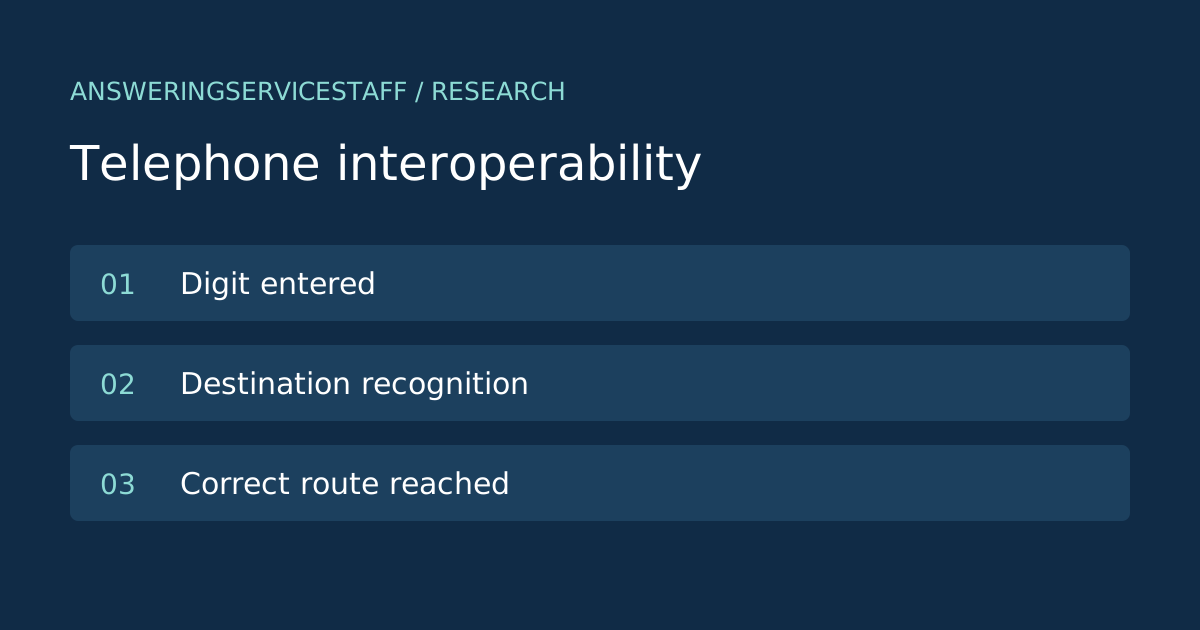
A caller can hear a menu clearly, press the requested key, and still fail to reach the right destination. Successful speech does not prove that keypad signaling survives every part of a forwarded or transferred call. For a business using an answering service, this can leave a receptionist unable to enter an extension or a caller trapped in a menu after a handoff.
This brief develops a focused acceptance test for keypad behavior. It draws on the telephone-event specification and uses hypothetical test cases. It does not claim that any particular provider has a defect or that a protocol label alone proves end-to-end compatibility.
Identify the actual business dependency
List the points where someone must press keys: selecting a department, entering an extension, accepting a transferred call, or confirming a menu choice. A route that needs no keypad input may work while a route through the same platform fails when an extension is required. Test the workflow the business depends on.
Distinguish the caller's actions from the receptionist's actions. A caller may press a key before the service answers, while the receptionist may send digits during a later transfer. These occur on different call legs and can encounter different handling rules.
Also distinguish keypad recognition from menu design. A menu can recognize the digit correctly and still route to the wrong destination because its configuration is wrong. The acceptance test should record both recognition and the resulting business destination instead of treating any audible response as success.
What the specification tells us
RFC 4733, published by the RFC Editor for the IETF, describes carrying named telephone events, including dual-tone multifrequency digits, in RTP packets. It discusses event identity, duration, ending, and negotiation of supported events. The document replaces RFC 2833 and has listed updates that technical owners should consider for their implementation.
The practical implication is narrow: telephone signaling has behavior beyond ordinary speech audio, and participating systems must handle the relevant events compatibly. The specification does not establish that a particular carrier, handset, gateway, or answering platform works with the business's complete route. That requires local evidence.
Understand why an audible tone is incomplete evidence
Hearing a tone at the originating phone shows that something audible happened there. It does not necessarily show what the far-end menu received. The path may carry signaling as named events, as audio, or through conversions managed by intervening equipment.
A technical owner may therefore ask which signaling method is negotiated on each relevant segment. Business staff do not need to choose packet formats during a customer call. They need a documented route that works and a clear way to report failures with enough context for the responsible specialist.
Avoid changing several signaling settings based on a single failed call. A change that repairs one route can affect another. Preserve the original configuration information, use an approved change process, and repeat the relevant acceptance cases after any correction.
Build a route matrix before testing
A practical matrix names the originating device or carrier category, entry number, forwarding condition, transfer type, and destination menu. Include the normal route and the overflow route if both are used. Mark which participant enters the digits and when that happens.
Start with the routes that would prevent useful service if they failed. For example, a receptionist's ability to reach the on-call extension may be more consequential than a rarely used informational menu. Prioritization does not justify ignoring the remaining routes; it determines the order of investigation.
Keep the matrix small enough to maintain but specific enough to reveal differences. “Phone works” is not a test case. “External test caller reaches the service through overflow forwarding, then the receptionist enters the designated test extension and reaches the expected destination” is a reproducible case.
Define success at the destination
Use a safe test destination with known expected behavior. Record the digit sequence entered, whether the destination recognized it, and where the call ultimately arrived. Never use genuine account access codes, payment details, or other sensitive information as test data.
A successful case requires the intended outcome, not merely the absence of a disconnect. If the menu times out and falls back to a default operator, the call may reach a person even though keypad recognition failed. That fallback can be useful operationally while still masking the defect under test.
Record failures separately: no digit detected, extra digit detected, wrong digit detected, correct digit but wrong routing, or timeout before entry. These categories direct the next investigation. Combining them into one failure count makes it harder to distinguish signaling from configuration or timing problems.
Exercise timing without creating unsafe traffic
Test ordinary deliberate key presses and realistic pauses between digits. Do not assume that one unusually long press represents normal use. Where the business depends on a sequence, test the full sequence rather than one isolated digit.
Consider when the destination is ready to accept input. Digits entered before the menu starts listening may be handled differently from digits entered after the instruction. The business needs to know the expected interaction, while the technical owner determines whether observed behavior reflects configuration or a transport problem.
Use clearly labeled test calls in an approved window. Do not send test traffic to public emergency numbers, real customer accounts, or unrelated organizations. A realistic acceptance test can use synthetic extensions and an authorized destination without exposing anyone to an unintended action.
Include transfers and forwarding explicitly
A direct call to a menu may pass while the same menu fails after a transfer. The transfer can change the media path or the systems responsible for signaling. Treat direct and transferred calls as separate cases rather than assuming that one validates the other.
Where the service supports more than one transfer method, document which method is part of the agreed workflow. A test of a consultation transfer does not automatically validate every other transfer mode. The result should name the tested method in language the operations team understands.
Forwarding conditions also matter. Busy-line overflow and scheduled after-hours forwarding may follow different routes. For after-hours and overflow coverage, the acceptance evidence should reflect those actual conditions. A daytime direct-call demonstration alone leaves the overnight route untested.
Connect technical evidence to customer handling
When keypad entry fails during an ordinary call, staff need an approved fallback. That may be a direct destination, a message to the responsible owner, or another documented contact path. It should not require the receptionist to improvise access methods or repeatedly attempt unknown codes.
For message taking and call routing, agree on what information accompanies the fallback message and who acknowledges it. The technical defect and the unresolved customer request are separate responsibilities. Fixing the route later does not automatically resolve the request that was waiting.
Track the affected call reference and symptom without copying sensitive digits into a general report. A technical owner may need controlled diagnostic access, but broad sharing of complete call recordings is rarely the first necessary step. Keep the evidence appropriate to the problem and the business's access rules.
Interpret a small test honestly
Suppose all twelve planned route cases pass once. The result establishes that those twelve cases worked under the tested conditions. It does not prove a quantified future reliability level or show that untested devices and carriers behave the same way.
Repeated checks across relevant conditions can increase confidence operationally, but the selection is usually purposive rather than a random sample of all calls. Report the scope and dates instead of turning a clean checklist into an unsupported percentage guarantee. An actual incident should trigger review even if the earlier checklist passed.
After a carrier change, routing change, or telephone-platform update, repeat the cases that could be affected. Keep the prior results so the business can see when behavior changed. The acceptance record is useful because it is specific and repeatable, not because it is permanently valid.
Use the result in supplier evaluation
Ask who owns the complete handoff when a keypad-dependent route fails. The answering service, business telephone administrator, and carrier may each control different segments. A useful agreement identifies how evidence is exchanged and who coordinates the next test rather than sending the business around in circles.
Compare suppliers on the routes the business actually needs and on their ability to investigate exceptions. A claim of protocol support is relevant technical context, but the purchase decision also requires a working operational path. Keep the distinction between documented capability and observed compatibility visible.
The resulting decision can be modest: accept the tested routes, retain an approved fallback, and resolve a specific failing route before relying on it. That is more informative than declaring every telephone function healthy because a single conversation sounded clear.
Source record and limitations
Source: RFC Editor/IETF, “RFC 4733: RTP Payload for DTMF Digits, Telephony Tones, and Telephony Signals,” December 2006, checked November 6, 2026 through the linked specification page. The protocol summary is limited to the signaling concepts needed for this business test design.
The route matrix, acceptance criteria, and examples are original analytical recommendations. No customer calls, vendor traces, or company reliability data were available. Implementation details and applicable specification updates require review by the technical owner; this article does not replace platform-specific configuration documentation.