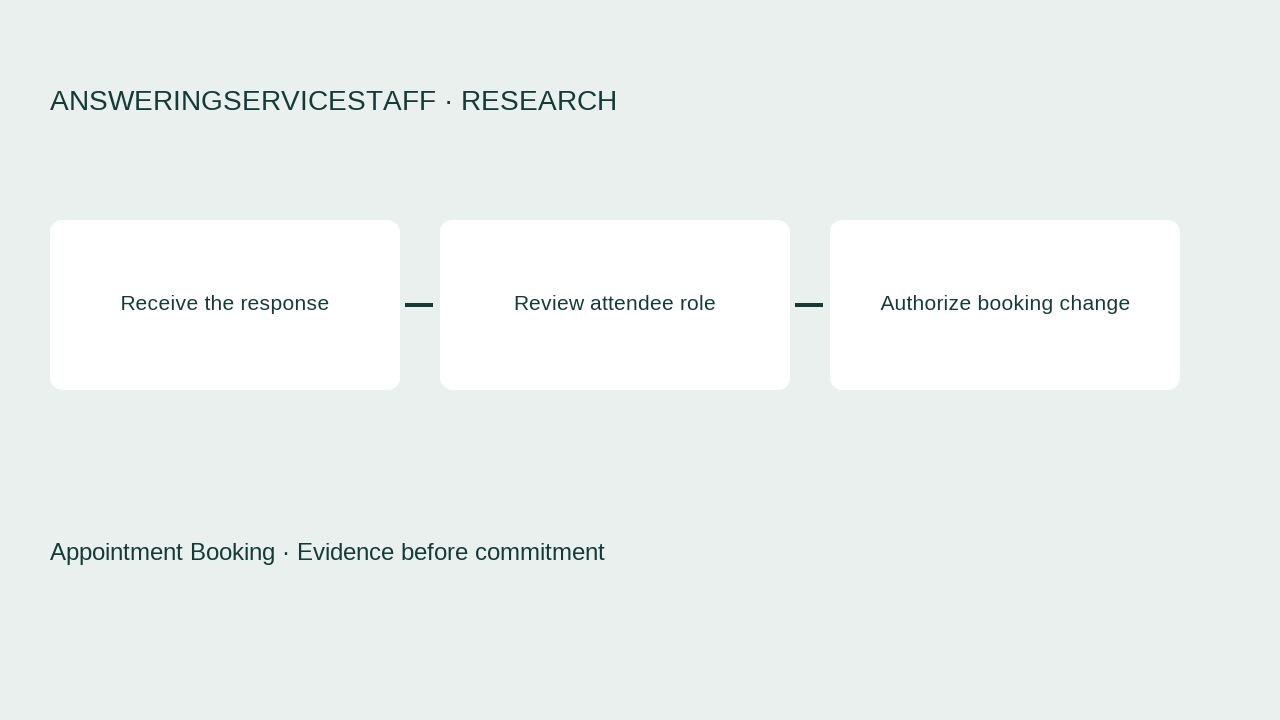
A customer can book by telephone and later decline the calendar invitation without calling again. The calendar may display the response while the business's appointment record still shows a confirmed visit. Before relying on an answering service to manage booking follow-up, a buyer should decide what that decline means and test whether the right person sees it in time to act.
What the calendar standard establishes
RFC 5545 distinguishes an attendee's participation status from an event's status. For an event attendee, participation values include accepted, declined, tentative, and needs action. Event status separately describes the event, including tentative, confirmed, or cancelled. The standard defines data representation; it does not determine a business's cancellation policy or promise that a booking platform automatically reconciles every response. RFC 5545, Internet Calendaring and Scheduling Core Object Specification.
Our operational inference is that an attendee decline should trigger the business's defined review rather than silently become either a cancellation or an ignored notification. This brief evaluates that response path. It does not address how long to reserve an unconfirmed slot or how to modify a recurring series.
Agree what a decline means in this business
Some businesses may treat a customer's decline as a clear request to cancel. Others may need clarification because the calendar invitation went to an assistant, an optional participant, or a shared mailbox. The interpretation must be explicit and communicated through the booking process. A receptionist should not improvise cancellation authority after noticing an unfamiliar calendar symbol.
Distinguish the person receiving the invitation from the person whose attendance is required. A household appointment might be arranged by one person for another. A commercial consultation might invite several employees, only one of whom is necessary for the meeting. The effect of one decline depends on those roles and the business's agreed policy.
Write a short rule for each supported case: automatic cancellation if specifically authorized, review before changing the booking, or no booking change for an optional participant. Record who owns clarification and how soon it must happen. This is a proposed operating rule, not a claim that the calendar standard requires any one interpretation.
Trace the response to an owner
Map the path from the customer selecting decline to the person responsible for the appointment. The response may reach an organizer mailbox, appear only in a calendar, or update a connected booking system. Inspect the actual path rather than assuming that the answering team receives everything visible to the business owner.
The key evidence is an actionable exception with a booking reference, the responding attendee, the received time, and an owner. A general notification that something changed is weaker because the recipient still has to discover what changed and which appointment it concerns. If the booking desk works only during certain hours, define how the next shift finds responses that arrive overnight.
Ask the provider to demonstrate a response received near the appointment start time. This reveals whether the queue prioritizes a decision that may affect an imminent visit. A system can deliver the information correctly yet leave it unread until after the customer was expected, so transport receipt is only one checkpoint.
Build a controlled booking-response test
Use a synthetic appointment and authorized test email addresses. Book it through the same telephone workflow planned for normal coverage. Record the booking identifier, organizer, invited attendees, expected start time, and agreed response policy. Confirm that the initial booking appears correctly before changing any attendee response.
Have the required attendee decline. Observe the calendar, the booking record, the receptionist's work queue, and any notification to the business owner. Compare the resulting state with the agreed policy. If review is required, the appointment should remain in an explicitly understood state while the exception has an owner; it should not disappear without explanation.
Then repeat with an optional attendee declining and with a required attendee changing from tentative to accepted. These cases show whether the integration distinguishes the meaning of responses rather than treating every change identically. The test is deliberately small and reproducible. It provides evidence about selected transitions, not a statistical estimate of all future booking errors.
Test changed responses and late arrival
A customer can change their mind after declining. The business needs to know whether a later acceptance restores an appointment automatically, requests review, or has no effect after a cancellation was finalized. Reopening a slot without checking current availability can conflict with a replacement booking, even if the original attendee now wants to attend.
Create a controlled sequence: decline, authorized cancellation, reassignment of the slot to a second synthetic booking, then acceptance from the original invitee. Observe whether the system flags the conflict and routes it to someone with authority. Do not allow the test to affect real appointments. The desired behavior follows the business's policy, but it must not silently promise the same resource to both parties.
Also test an older response arriving after a newer one. Ask the implementation owner how response ordering is interpreted and what evidence the operator can inspect. This brief does not prescribe a particular synchronization algorithm. It recommends that uncertain ordering remain visible instead of being converted into a confident but unsupported booking state.
Preserve the difference between customer intent and completion
A decline is evidence of an attendee's response to an invitation. It may express cancellation intent, but completion of the business action can require further steps. A receptionist might need to release a resource, notify a service team, apply an approved cancellation process, or clarify whether another attendee will still attend.
Keep those actions distinct in the record. For example, received decline, cancellation reviewed, calendar updated, and customer contacted describe different events. A single closed label can hide an unfinished step. The business should decide which events are required for its appointment type and which are unnecessary, rather than adopting a long checklist without a purpose.
This distinction is especially useful when a customer later asks what happened. The team can explain what response was received and what action followed without claiming that the calendar application made the entire decision. Clear records also help resolve whether a missed visit resulted from an unprocessed decline, a misunderstood role, or a separate operational problem.
Choose measurements that reveal missed decisions
Measure the time from receipt of a response requiring review to assignment of an owner, then to the final authorized disposition. Include unresolved responses and their age at the end of the observation window. A report of completed cancellations alone excludes the declines that nobody noticed, which are the cases the buyer most needs to understand.
Use counts appropriate to the test. In a hypothetical set of twelve responses, perhaps eight require review under the agreed policy and four concern optional participants. The review denominator is eight, while the total response count remains twelve. Mixing those counts can make the team look slower or faster without any change in actual handling.
Record incorrect automatic changes separately from delayed review. Instantly cancelling a valid multi-attendee appointment after an optional participant declines is not a success simply because it happened quickly. Correct interpretation and authorized action must accompany timeliness. These proposed measures are for local evaluation; we have no primary evidence supporting a universal response-time benchmark for all answering arrangements.
Methodology, uncertainty, and the buying decision
This brief uses a primary calendaring specification to distinguish two kinds of status, then develops an original operational test for telephone-booked appointments. We did not inspect proprietary calendar integrations or customer cancellation data. Client applications can expose responses differently, and an integration may support only part of the standard. The buyer must verify the exact tools and roles in the intended workflow.
For appointment booking, bring the cancellation policy and attendee roles into the setup conversation. If responses can arrive outside office hours, include them when discussing overflow and after-hours coverage. A useful coverage discussion should establish who reviews declines, what authority they have, and how an unresolved response remains visible until the business makes the required decision.
Source record
Publisher: RFC Editor / Internet Engineering Task Force. Title: RFC 5545, Internet Calendaring and Scheduling Core Object Specification (iCalendar). URL: https://www.rfc-editor.org/rfc/rfc5545.html. Checked November 13, 2026. Status definitions are sourced; procedures, example counts, and operational conclusions are proposed analysis rather than observed service results.