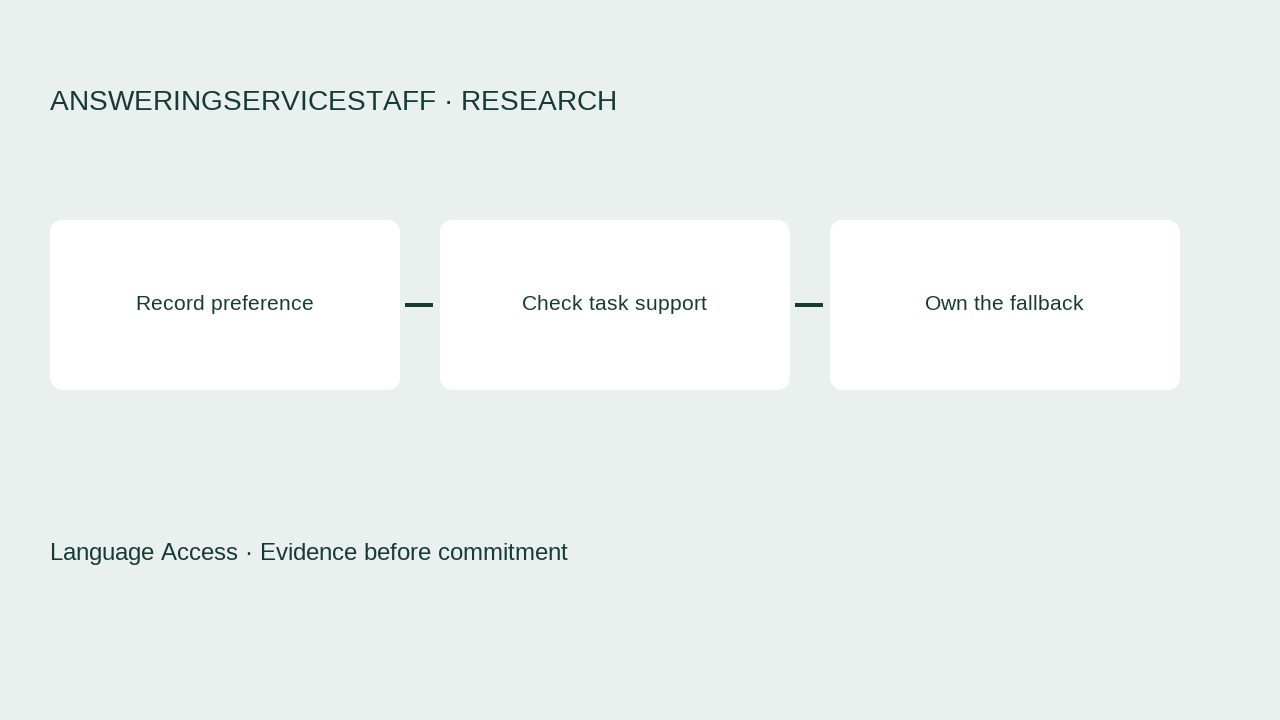
A caller asks for help in a preferred language, but the routing system has only a broad language label and a default destination. The call reaches someone who can greet the customer but cannot complete the intended task. The queue assignment looks successful while the customer still lacks usable help. Evaluating language routing requires more than counting how many language names appear in a menu.
This research brief examines how language preferences move between telephone intake, routing rules, and an available support resource. It focuses on matching and fallback behavior. It does not estimate local language demand, certify interpreter competence, or provide a legal compliance assessment. The practical decision is whether the business can preserve a caller's stated preference and recognize when a nominal match is insufficient.
What language matching actually specifies
The IETF's RFC 4647, Matching of Language Tags, distinguishes filtering, which can return a set of matching tags, from lookup, which selects one result. Applications must define how they use matching and what happens when no suitable result is found. Language tags support structured preference handling; they do not establish a person's ability to perform a particular conversation.
Our operational analysis starts at that boundary. A software match can select a resource label, but the business still needs to determine whether the resource is available and suitable for the task. A receptionist's conversational ability, a qualified interpretation service, and a translated written template are different capabilities even if they share a language label.
Record a preference without turning it into an identity assumption
Ask the caller which language they prefer for the current interaction when the normal workflow permits that question. Do not infer the answer from a name, telephone number, accent, or location. The caller may prefer different languages for a brief scheduling exchange and a detailed discussion with the business owner.
Preserve the stated preference as an operational request. If the system requires a structured selection, allow staff to retain clarifying information in the approved field rather than forcing an unsupported category. A narrow list can make data look clean while discarding the very distinction needed for a successful handoff.
Also distinguish “not asked,” “declined to state,” and “no supported option available” where the system allows it. Treating all three as a default language hides different problems. The first may be a process omission, the second a caller choice, and the third a service limitation requiring an explicit next step.
Inventory resources by task and availability
Before writing fallback rules, list the resources the business has actually authorized. For each one, record the tasks it may handle, its hours or availability method, and the escalation owner when it cannot accept a call. Do not turn a staff member's informal statement about language ability into a broad service commitment.
A resource that can confirm a callback number may not be authorized to discuss a technical, clinical, financial, or legal matter. The routing decision should therefore consider the purpose of the call as well as the language preference. This brief does not set professional qualification rules; those belong to the business's responsible experts.
Availability must be observed at the time of routing. A language option listed in a directory is not proof that someone can answer now. If the resource is unavailable, the system should preserve the original request while following a preapproved fallback rather than silently rewriting the record to match whoever is free.
Make fallback an explicit business decision
A fallback can mean several things: offer a callback with the requested resource, connect an approved interpretation service, or ask whether another available language is acceptable. Those options should be chosen according to the business's obligations and the caller's needs. They should not emerge accidentally from a software default.
If the caller agrees to an alternative, record the agreement for that interaction. Do not permanently overwrite the preferred-language field merely because one conversation used another language. A temporary accommodation and a durable preference change are different facts, and confusing them can affect future calls.
A caller who cannot use the offered alternative should receive a clear next step. The script should identify the owner and describe what the business can actually arrange. Staff must not promise an unsupported language, a particular response time, or a specialized interpreter unless that capability and commitment have been established.
Design acceptance cases around the unresolved branch
Use synthetic caller scenarios and controlled staff participation. Include an exact supported preference, a more specific preference than the directory stores, multiple available resources, and no available match. For each scenario, define the intended route and the acceptable fallback before testing the system.
Add a case in which the first resource declines because the task is outside its authority. This tests whether the original preference survives the second handoff. A workflow that records only the first transfer can make the interaction appear resolved while the caller is still waiting for someone who can help.
Include a caller who declines the proposed fallback. The correct result is not a forced completion. It is an accurately recorded unresolved request with an authorized owner and next action. The acceptance reviewer should confirm that staff can choose this state without disguising it as a successful language match.
Observe the handoff from both sides
The receiving resource should see the stated language preference, the limited purpose of the call, and any accepted alternative. The caller should not need to repeat the whole request simply because the routing label changed. Keep the handoff concise and avoid unnecessary sensitive detail in the routing note.
Ask the receiver whether the request falls within their supported work. A successful connection is only the first observation. The business also needs to know whether the receiver accepted responsibility for the intended next step. If responsibility is declined, the original desk or another named owner must retain the case.
Check how the result appears in reports. A transfer to a bilingual queue should not automatically become a completed language-service interaction. The record should distinguish routed, connected, accepted, completed within scope, and unresolved where those distinctions matter to the business promise.
Measure failures without overstating language coverage
For the controlled test, report each case and its outcome rather than a headline coverage percentage. A small set of preferences cannot represent every dialect, writing system, or conversational context. It can reveal whether the matching rules and exception process preserve the information needed for a usable handoff.
During a pilot, separate no-match events from unavailable-resource events and task-scope refusals. These categories point to different improvements. Adding another label to the directory will not fix an availability gap, and extending hours will not fix a resource that lacks authority for the caller's request.
If reporting a rate, state which calls were eligible and how unknown preferences were handled. Excluding callers whose needs were never captured can make coverage look better than the observed service. The analysis should make those omissions visible without inferring a language preference that the caller did not provide.
Turn the findings into a buying requirement
For live call answering, ask the provider to demonstrate how it records a preference and handles an unavailable match using the proposed tools. For customer support intake, also demonstrate a task-scope refusal and the resulting ownership handoff.
The agreement should state the supported capabilities and the limits of the fallback. Avoid treating a general claim of multilingual support as evidence for every possible interaction. A narrower, demonstrable process gives the business and the caller a more reliable expectation than a broad label with an unexplained default.
Review the process when the resource directory changes. New staff, changed hours, or a different interpretation arrangement can alter the effective route without changing the caller-facing menu. The test should remain tied to the current resource list and should include the unresolved path, not only the easiest supported conversation.
Source and limitations
Primary source: RFC Editor / IETF, RFC 4647: Matching of Language Tags, checked November 9, 2026. The source supports the technical matching distinction only. The call scenarios, task boundaries, and acceptance method are original analysis; no private demand or language-service outcome data was available. Use a coverage planning discussion to document supported preferences, fallback choices, and the owner of an unresolved request.