A ten-digit phone number looks like a small piece of data. On a live call, it behaves like a larger one. The caller may be reading from a screen, holding a child, driving, or translating from another language. The agent may be typing while listening, and the line may cut out on a consonant. When a callback number is wrong, the error often surfaces hours later as an unreachable message.
Memory research does not produce a universal rule for phone intake. It does support a narrower design principle: reduce the number of separate items a person has to retain at one time, and verify the record while the source is still present. That principle is more useful than a fixed “read it back twice” instruction.
What the published research supports
Miller's 1956 paper described limits on the amount of information people can process and introduced the idea that memory capacity is often discussed in chunks rather than individual sensory items. The paper is frequently summarized as “seven plus or minus two,” but Miller himself treated the number as a rough estimate and a rhetorical device, not a precise constant.
Cowan's 2001 review examined a wide range of short-term memory experiments and argued for a smaller capacity limit, commonly described as about three to five chunks under controlled conditions. Cowan also emphasized boundary conditions: estimates change when rehearsal, long-term memory, or grouping strategies are available.
Neither paper studied answering-service calls. Neither supplies a target digit span for callers, and neither says that a ten-digit number is inherently too long to remember. The relevant lesson is conditional. When information is grouped into meaningful chunks, people can retain more of it. When grouping is absent or the task is interrupted, retention falls.
That distinction matters because a phone number is not a random string to the person who owns it. A caller can often recall their own number as a familiar pattern. The harder task is transferring that pattern accurately to a second person who is typing it into a record while other parts of the call continue.
Why the callback number is a special case
Most fields in an intake record can be corrected later. A misspelled street name may still be searchable. A wrong callback number can break the only path back to the caller. The record may look complete while being functionally unreachable.
Several features of the phone channel increase the risk:
- The agent and caller cannot see the same screen, so neither can point to the field that is wrong.
- Digits with similar sounds are easy to confuse on a compressed line.
- Callers often say numbers in a rhythm that does not match how the agent types them.
- The conversation continues while the agent is still entering the previous answer.
- A caller who is interrupted may repeat a different version of the number without noticing.
A readback that asks, “Is that right?” after a fast recitation does not solve these problems. It asks the caller to compare a long string held in memory against another long string heard once. That is a memory test disguised as verification.
Build the verification around chunks
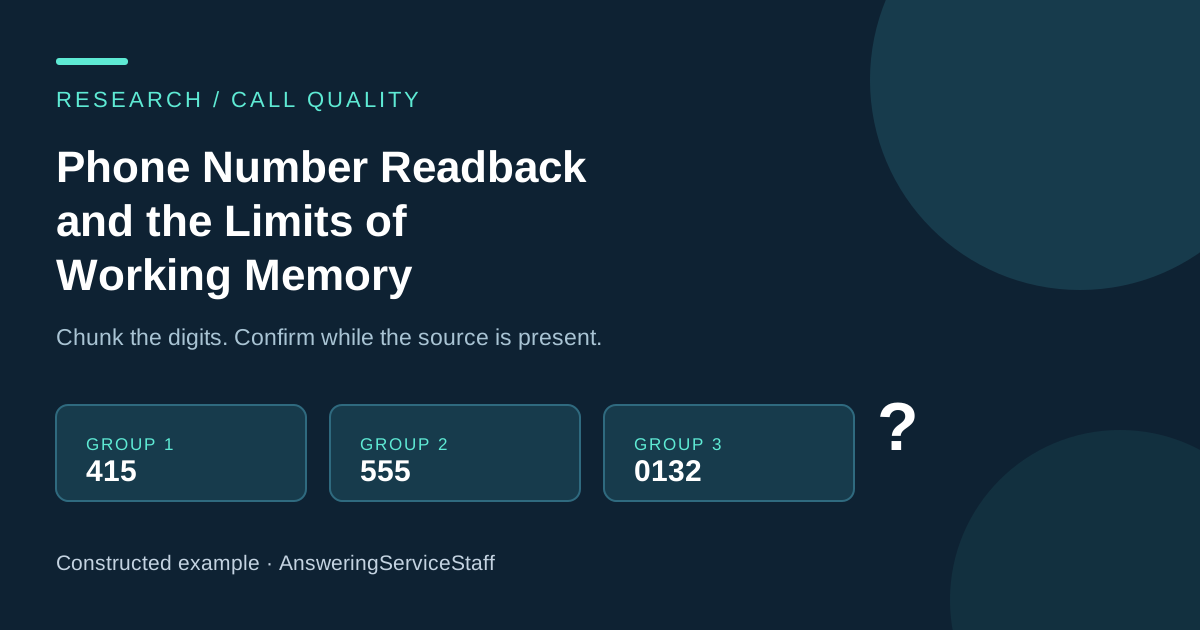
A more defensible protocol breaks the number into familiar groups, confirms each group while it is fresh, and then confirms the whole record.
For a North American number, a common grouping is three digits, three digits, and four digits. The agent can say the groups with a short pause and ask for confirmation after the final group, or confirm the area code and exchange before the last four digits. The exact grouping should match how the client's customers usually say numbers, not a theoretical ideal.
A practical sequence looks like this:
- Ask the caller to say the number slowly, once.
- Enter it without interrupting with unrelated questions.
- Read it back in the same groups the caller used, if those groups are clear.
- Ask the caller to confirm the group that is most likely to be misheard, rather than repeating the entire string.
- If any group is corrected, read the corrected group and then the complete number once.
- Record that verification happened, not just the number itself.
The final step is easy to overlook. A note that contains ten digits does not show whether the caller confirmed them or whether the agent typed from memory. A short verification marker separates an unconfirmed capture from a confirmed one.
Do not make the caller do the remembering
Some scripts inadvertently shift the burden back to the caller: “I'll read it back, and you tell me if any digit is wrong.” That instruction asks the caller to hold the original number in mind while listening to a second version. Under interruption, the comparison is unreliable.
A better approach is to confirm one group at a time. The caller only needs to compare three or four digits, and the agent can stop at the first disagreement. This also makes corrections easier to log. Instead of replacing an entire number, the agent can record that the last four digits changed after verification.
The same logic applies to email addresses and account numbers, but the failure modes differ. Email addresses contain words and symbols that callers often spell differently. Account numbers may have check digits or formatting rules. A single readback script should not be stretched across every identifier without deciding what “confirmed” means for each one.
Measure number accuracy without inventing a benchmark
A business does not need an industry error rate to improve its own process. It needs a defined denominator and a consistent way to classify failures. A workable measurement plan is:
- Count calls where a callback number was required.
- Count calls where the number was confirmed by the caller.
- Count returned or unreachable callbacks attributable to a number defect.
- Count corrections made during the call and corrections discovered afterward.
The resulting rates describe the operation's own records. They do not establish a universal standard, and they should not be presented as one. A low observed error rate in a small sample is also not proof that the process is safe. The sample size and the selection method limit what the rate can support.
One useful internal comparison is between calls where the agent used the chunked protocol and calls where the agent did not. That comparison is still observational. Agents may use the protocol more often on complex calls, and the calls themselves may differ in ways the record does not capture. The result can guide a coaching decision, not prove causation.
A constructed example
Consider a plumbing dispatcher reviewing 40 call records from one week. Ten records contain a callback number that was entered but never confirmed. Of those ten, two later produce an unreachable callback. The other 30 records contain a confirmation marker, and one of those produces an unreachable callback after the customer changes carriers.
The numbers are invented for illustration. The important part is the split. The unconfirmed group has a visible gap in evidence, while the confirmed group has a different failure story. Reporting only “three unreachable callbacks out of 40” would hide both patterns.
A manager could then listen to the unconfirmed calls and ask a specific question: did the agent skip verification because the caller was in a hurry, because the field was buried below other prompts, or because the script did not require it? Those are fixable causes. “Be more careful” is not.
Where the protocol can fail
Chunking is not a cure for a bad line. If the caller is breaking up, the agent should say so and offer a callback rather than pretending the number was verified. Repeating digits into a noisy connection can produce false confidence.
The protocol also assumes the caller knows the number. A caller using a borrowed phone may give someone else's number, and a caller who is moving may give a number that will soon be disconnected. Verification confirms the digits, not the usefulness of the destination. The intake record should distinguish “number confirmed” from “number belongs to the caller and will be reachable.”
Language and hearing differences matter as well. A caller who is reading digits in a second language may group them differently, and a caller with hearing loss may need the agent to slow down rather than repeat louder. The script should allow the agent to adapt the pace without skipping confirmation.
What to change on the next shift
The operational takeaway is modest and testable. Shorten the memory task, confirm in groups, mark the confirmation, and review the records where confirmation is missing. These steps do not depend on a disputed capacity number, and they do not require the business to claim a benchmark it cannot support.
If the current script ends with “Can you confirm your number?” after a single fast recitation, the first change is to replace that question with a group-by-group check. The second is to record the result. The third is to listen to a small sample and see whether the change survives contact with real callers. That is a more honest use of memory research than turning a laboratory estimate into a phone script rule.