A receptionist answers a call from a woman who says she is ringing about her father's appointment. She knows the date, the address, and the name of the regular technician. She wants to move the visit to Thursday and asks whether the fee will change. The call sounds routine. It may still be a request the business has no authority to complete.
Third-party calls are awkward because the caller often has real context and good intentions. The agent cannot treat context as proof of authority, and cannot treat a lack of formal paperwork as proof that the request is improper. What the agent can do is build a record that shows the basis for the action taken. That record is the difference between a helpful exception and an unexplained disclosure.
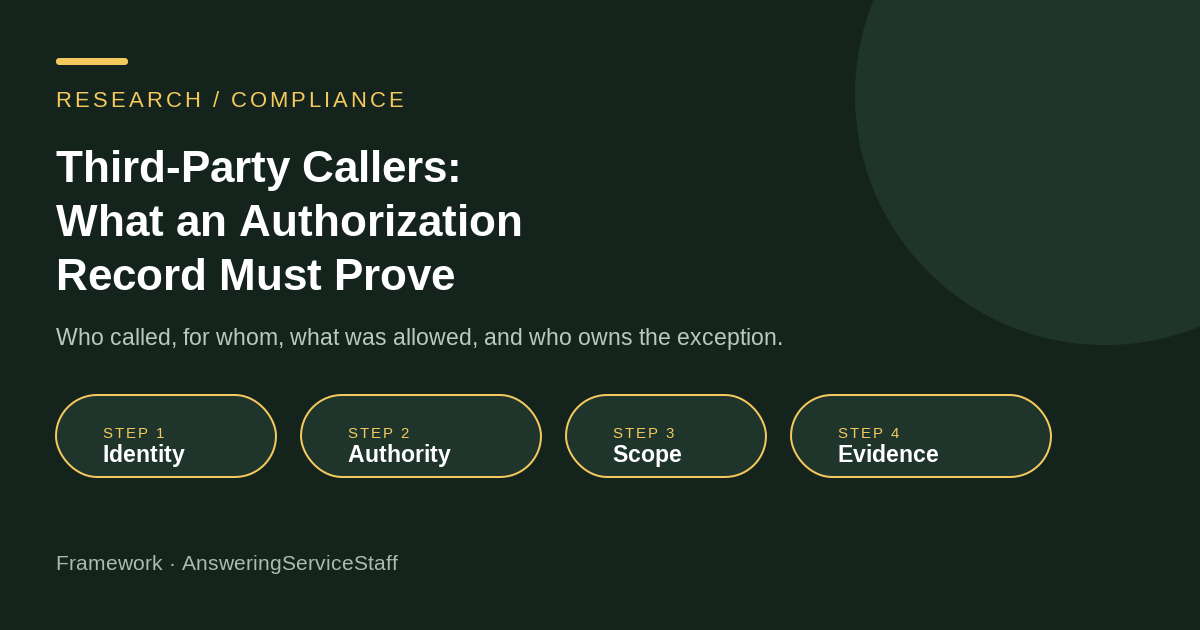
Identity, authority, and scope are separate questions
Phone intake often collapses three questions into one: “Can I help you?” A more defensible process separates them.
Identity asks whether the person on the line is who they claim to be. On a phone call, identity evidence is limited. Caller ID can be spoofed, a date of birth can be known by relatives, and a familiar voice can be imitated. The agent should not describe a weak check as verification.
Authority asks whether that person is permitted to act for the account holder or patient. Authority may come from a signed authorization, a legal role such as guardian or power of attorney, a lease, a business role, or a client-specific rule. It is a status, not a personality trait.
Scope asks what the person is allowed to do on this call. Authority to discuss an appointment is not necessarily authority to change payment details, cancel a contract, approve a repair above a threshold, or receive clinical information. Scope should be written down before the call arrives.
A record that captures only “daughter called” answers none of these questions. A record that captures “daughter, authorized contact on file, may reschedule but not discuss billing” answers all three at the level the business needs.
What the published rules contribute
The HIPAA Privacy Rule provides a concrete example of how authority can be defined. 45 CFR § 164.502(g) requires covered entities to treat a personal representative as the individual for many purposes under the rule, while also recognizing limits and exceptions, including certain situations involving unemancipated minors. The provision is not a universal script for every industry, and it does not tell an answering service how to verify a caller. It does show that “acting for someone else” is a legal status that must be established, not inferred from the reason for the call.
45 CFR § 164.514(d) adds a narrowing principle. Routine disclosures should be limited to the information reasonably necessary to achieve the purpose, and non-routine requests need criteria and individual review. For phone intake, the practical translation is straightforward: even an authorized caller does not automatically receive every detail attached to an account. The agent should disclose what the requested action requires, not everything the screen contains.
NIST's Digital Identity Guidelines, SP 800-63-3, distinguish identity proofing, authentication, and federation assurance. A phone call does not satisfy those digital assurance levels, and this article does not claim that it does. The useful contribution is conceptual: proving an identity is a different problem from deciding what an authenticated party may do. An intake process that treats a successful identity check as blanket permission has skipped the authorization question.
Define the authorization model before the script
An answering service cannot make policy for its clients. It can require each client to state one. A workable client brief should identify:
- which roles may call on behalf of an account holder;
- what evidence the agent may accept for each role;
- which actions each role may request;
- which actions require the account holder's direct confirmation;
- how long an authorization lasts and when it must be renewed;
- who may grant an exception, and how that decision is recorded.
The brief should be specific enough that two agents would make the same decision on the same call. “Family members may call” is not a rule. “A spouse on the authorized-contact list may reschedule and confirm attendance; billing changes require the account holder” is a rule.
For non-healthcare businesses, the same structure applies with different evidence. A property manager may accept a tenant's maintenance request but require the owner's approval for a repair above a stated amount. A home-service company may let an adult child book an estimate for a parent but not authorize work. A commercial client may let an office manager place a service call but not approve a purchase order. The categories are consistent even when the underlying law is not.
Capture evidence, not impressions
A third-party authorization record should be readable without the audio. At minimum, it should show:
| Element | Question the record answers |
|---|---|
| Caller | Name, callback number, and relationship to the account |
| Subject | Account holder, patient, tenant, or business the call concerns |
| Authority source | On-file authorization, legal role, lease, client rule, or direct confirmation |
| Scope | Actions permitted on this call |
| Evidence checked | What the agent actually saw or heard, without overstating it |
| Decision | Action taken, refused, or escalated |
| Owner and time | Who reviews the exception and when |
The evidence field is where many records fail. “Verified identity” is not evidence. “Confirmed name and date of birth on file; caller could not provide authorization code; routed to client for approval” is evidence. The first phrase implies a standard the agent may not have met. The second tells a reviewer exactly what happened.
The record should also distinguish a caller's claim from a fact the business holds. “Caller states she is the daughter” is accurate. “Daughter” is an inference. If the account has an authorized-contact field, the record should say whether the caller matched it, not simply repeat the relationship the caller used.
A constructed call review
Suppose a dental practice receives a call from a man who says his wife is a patient and wants to cancel her Thursday cleaning. The client brief says a spouse on the authorized-contact list may cancel and reschedule, but may not discuss treatment or account balances.
The agent confirms the patient's name and the appointment, checks the authorized-contact field, and finds the spouse listed. The caller asks whether the cleaning will still be covered after a recent insurance change. That question falls outside the spouse's scope. The agent should complete the cancellation if the brief allows it, decline the insurance discussion, and offer to have the office call the patient directly.
A weak record would say: “Husband called to cancel; insurance question answered.” A defensible record says: “Spouse matched authorized contact; canceled Thursday 2 p.m. cleaning per client rule; insurance question outside spouse scope; message sent to billing for patient follow-up.” The second version shows the authority source, the action, the boundary, and the handoff. The numbers and names are invented, but the structure is the point.
Where third-party intake breaks
The first failure is blanket authority. An agent learns that a caller is a spouse and then answers every question on the screen. The second is blanket refusal. An agent decides that no third party can ever act, even when the client has provided a signed authorization. Both failures come from not having a scope rule.
The third failure is stale authorization. A contact list may be years old, a guardianship may have changed, or a tenant may have moved out. The brief should state a review interval and what the agent should do when the record looks outdated. “Escalate to the client” is a valid outcome; it is not a failure of service.
The fourth failure is over-collection. To avoid a bad disclosure, an agent may ask for a Social Security number, a full date of birth, or a copy of a legal document on a routine reschedule. Collecting more identity data than the action requires creates a new privacy problem. The minimum-necessary principle is useful here even outside healthcare: ask for what the decision needs, not for everything that might be useful someday.
Measure the process, not the caller's tone
A quality review can track third-party calls without judging whether the caller sounded trustworthy. Useful measures include the share of calls with a documented authority source, the share with a scope decision recorded, the number of requests escalated for approval, and the number of actions later reversed because authority was missing.
These measures describe the operation's own records. They do not establish an industry benchmark, and a clean sample does not prove that every call was handled correctly. A small review can still reveal whether agents are documenting the same elements or inventing their own version of verification.
The review should include calls that were refused as well as calls that were completed. A refusal with a clear reason is easier to defend than a completion with no record. It also gives the client something concrete to correct: a missing authorization, an unclear role, or a scope rule that does not match how families and businesses actually operate.
The record is the control
Third-party calls will never be fully scripted. People call for reasons the brief did not anticipate, and some of them have authority the file does not show. The goal is not to eliminate judgment. It is to make judgment visible.
When the record shows who called, whom the call concerned, what authority was checked, what action was allowed, and who owns the exception, the business can review the decision later. Without those elements, the only remaining evidence is a memory of the conversation. That is not a control, and it is not fair to the caller, the agent, or the client.