A receptionist can finish a conversation and still be unable to answer the next call safely. The appointment may need confirmation, the message may need routing, or the receiving employee may need clarification. A staffing calculation based only on connected talk time omits that work and can make a busy operation appear comfortably staffed.
This brief offers a workload accounting method for businesses deciding when to add live answering or overflow coverage. It uses constructed examples, not measured AnsweringServiceStaff productivity. It does not prescribe a universal occupancy target or promise an answer speed. The objective is to expose missing work before a business converts average call minutes into a staffing commitment.
What the sources establish
The Bureau of Labor Statistics description of receptionists includes answering and transferring calls alongside scheduling and other administrative duties. That supports examining the full role rather than treating the telephone conversation as the entire job. It does not provide a handling-time standard for an outsourced answering service.
NIST's Poisson distribution reference describes a model for event counts in a time interval. This brief uses it only for a simple arrival-variability illustration. Real business calls can be clustered, time-varying, and dependent, so the model must not be assumed to fit without checking.
Account for work in nonoverlapping categories
For each eligible conversation, record connected talk time, any hold time that occupies the answering worker, and required after-call work. Define when the worker becomes available for a new call. That availability event matters more for capacity than the moment the caller disconnects.
Distinguish work that must be completed before another call from work that may be safely deferred. A callback destination might need immediate verification, while a nonurgent summary may be completed within an approved later window. Deferral changes the timing of demand; it does not make the work disappear.
Avoid counting the same minute twice. If a system records hold time within connected duration, adding it again overstates workload. If two employees work on the same request at once, both employees' time may matter for cost, but the inbound answering queue may depend on only one of them. State which capacity question the measure answers.
A constructed hourly calculation
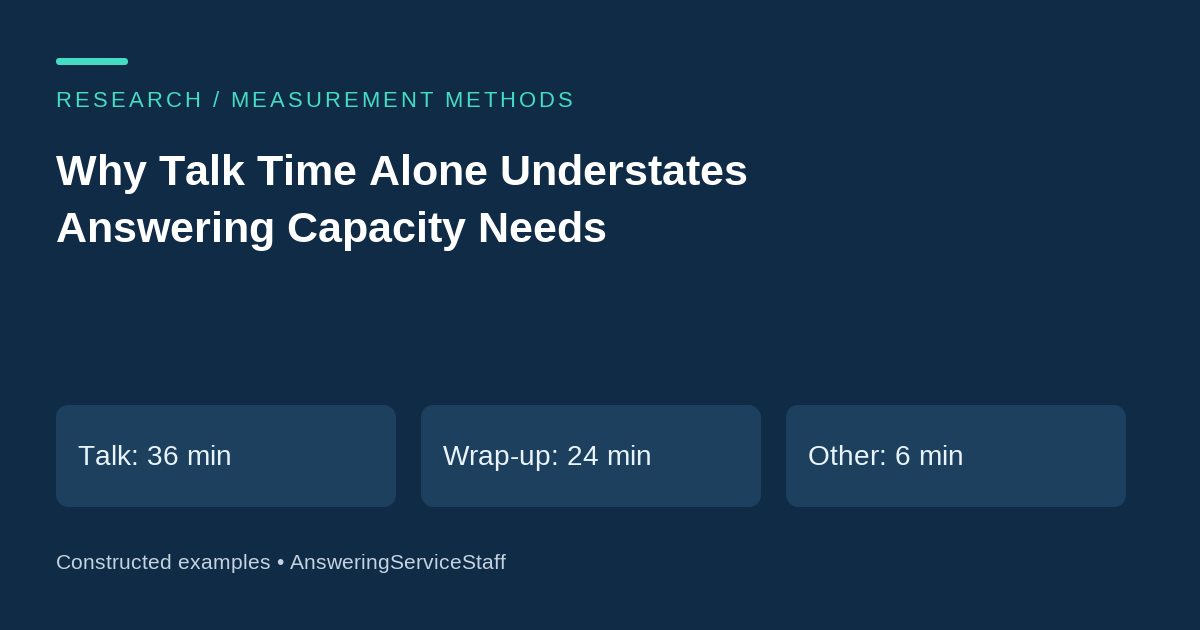
Consider twelve calls arriving in an hour. Each requires an average of three minutes of conversation and two minutes of required wrap-up. Talk time totals 36 minutes, but total handling work is 60 minutes. A calculation using talk alone would imply 24 spare minutes that do not actually exist in this example.
Now add six minutes of scheduled non-call work that must occur during that hour. Total required work becomes 66 minutes for a single worker with 60 clock minutes. The arithmetic identifies a workload deficit even before accounting for arrival timing, breaks, interruptions, or variation between individual calls.
| Component | Constructed assumption | Required minutes |
|---|---|---|
| Conversation | 12 calls times 3 minutes | 36 |
| Required wrap-up | 12 calls times 2 minutes | 24 |
| Other scheduled work | One 6-minute task | 6 |
| Total | Same hour, one worker | 66 |
This is a workload budget, not a queue simulation. It cannot estimate abandonment, waiting time, or the precise number of workers needed. It does show that a plan based on 36 talk minutes would omit nearly half the work in the constructed scenario.
Average workload is not an answer-time guarantee
Even an hour containing only 30 minutes of work can include two calls arriving simultaneously when one worker is available. One caller may wait or use another route. The order and overlap of work matter, not just the total minutes.
Under a hypothetical Poisson arrival model averaging one call per five-minute interval, the probability of two or more arrivals in an interval is 1 minus two divided by the mathematical constant e, approximately 26.4 percent. This calculation illustrates variability around an average; it does not establish the probability that a real caller will wait.
Waiting also depends on handling-time distributions, available staff, routing, patience, and work already in progress. Calls arriving in the same interval do not necessarily overlap, and calls in adjacent intervals can overlap. Use event-level timing or a validated queue model when a specific service-level prediction is required.
Measure at the scale of the decision
A daily total can hide a difficult lunch period or the first hour after opening. Examine shorter intervals that correspond to the coverage decisions the business can actually make. Fifteen- or thirty-minute views may be useful starting points, but choose a resolution supported by the volume and operational schedule.
Keep arrival time separate from work-completion time. A long call crossing an interval boundary contributes workload to both intervals, although it has only one arrival. Assigning all its handling minutes to the arrival interval can distort the apparent pressure around schedule changes.
Record local time consistently, including daylight-saving transitions when relevant. A repeated or skipped clock hour can confuse simple grouping. Preserve timestamps that identify the actual instant and use the business's named timezone for scheduling interpretation. Do not infer the caller's location from a telephone area code.
Examine the distribution of wrap-up work
An average wrap-up duration can hide a small set of labor-intensive requests. Separate straightforward messages, appointment changes, multi-step transfers, and requests requiring clarification when those categories are reliably recorded. A change in call mix can raise workload even if the number of calls stays constant.
Look for avoidable re-entry and unclear instructions before asking staff to finish faster. If every message must be copied into two systems, reducing the reported wrap-up allowance will not eliminate the second entry. It may instead create a backlog or increase mistakes that require later correction.
Keep deferred work visible as an outstanding workload. Report its age and required completion window, not just the number of records. An answering operation that looks available because all documentation is postponed may be accumulating obligations that disrupt the next shift.
Treat occupancy as a defined measure
A business may calculate occupied time divided by staffed available time, but both terms need definitions. Does occupied time include required documentation? Does available time exclude scheduled breaks, training, and other assigned duties? Different answers produce different percentages from the same day.
A high occupied share is not automatically evidence of efficient service, and a low share is not automatically waste. A business may deliberately retain spare capacity for variable arrivals, urgent routing, or a required answer-time objective. The appropriate balance depends on service risk, staffing flexibility, and the cost of waiting.
Avoid adopting an industry percentage without matching its workload definition and operating model. A pooled answering team, a solo receptionist, and a receptionist who also greets visitors do not have interchangeable availability. Ask the provider to show how its capacity commitment relates to the actual work included in the agreement.
Compare coverage options with the same workload boundary
When comparing in-house coverage and an answering service, include the work that remains with the business after the provider's handoff. A provider may capture a request while the internal team still resolves it. Counting only the provider's minutes can exaggerate the amount of work removed from internal staff.
For appointment booking, define whether the service confirms the slot, handles calendar exceptions, and communicates the result. For after-hours and overflow coverage, define when calls enter overflow and who completes documentation afterward. Capacity estimates should follow those responsibilities.
A practical trial can record arrival times, occupied intervals, deferred work, transfer outcomes, and receiving-team effort. Compare like periods and preserve unusual events rather than deleting them because they make averages inconvenient. The purpose is to understand the workload under the proposed arrangement, not merely produce a lower headline handling time.
A useful purchasing conclusion
The owner should receive a workload breakdown, interval-level pressure, outstanding after-call work, and an explanation of the assumptions behind any staffing estimate. Where data are missing, give a range or identify the measurement needed before committing to a precise coverage plan.
The analysis may show that the problem is a narrow afternoon overlap, a documentation bottleneck, or a consistently under-resourced shift. Those findings lead to different responses. Additional live answering may help, but only if the handoff and retained workload are included in the plan.
Talk time remains useful for understanding conversations. It becomes misleading when treated as the entire capacity requirement. A defensible coverage decision follows the request through the work needed to make the conversation useful, while leaving room for the fact that callers do not arrive on an evenly spaced timetable.
Sources and review date
-
U.S. Bureau of Labor Statistics. Receptionists: Occupational Outlook Handbook. Checked November 2, 2026.
-
National Institute of Standards and Technology. Poisson Distribution. Checked November 2, 2026.