A business should pay close attention to unusual transfers and urgent messages. But if those calls make up most of the review sample, their error rate cannot simply be reported as the error rate of every call. The sampling plan has changed the mix. Good oversight requires both focused investigation and a defensible estimate of routine performance.
This research brief proposes a two-purpose review design for businesses buying message taking, after-hours routing, and customer support intake. The counts are invented for arithmetic demonstration. They are not customer results, provider comparisons, or evidence of a particular failure rate. The recommendations concern measurement and do not replace the business's handling rules for urgent situations.
Why sampling weights appear
The U.S. Census Bureau's SIPP weighting explanation describes how observations can represent different numbers of population units when selection probabilities differ. It also distinguishes base weights from later adjustments. The business application here is simpler: account for deliberately different sampling fractions across predefined call groups.
NIST's sample-size guidance connects review effort to the intended precision and decision risk. There is no universal sample size in this brief. A manager must decide whether the review is intended to discover problems, estimate prevalence, or support a specific operational decision.
Separate discovery from estimation
A discovery review can deliberately examine complaints, failed transfers, and difficult conversations. Its purpose is to identify failure mechanisms and improve handling. It should report what was found in that selected set, without implying that the set represents ordinary calls.
An estimation review needs a defined population and known selection method. A simple random sample of all eligible requests is one option. A stratified random sample, with different sampling fractions for different categories, is another. The latter can provide more information about rare categories while retaining a route to a population estimate.
Keep the two lists distinct even if the same reviewer handles both. A complaint that enters a targeted investigation should not quietly be inserted into the random sample. If an observation appears in both, preserve the reason for each inclusion and prevent duplicate counting in the population estimate.
A worked unequal-sampling example
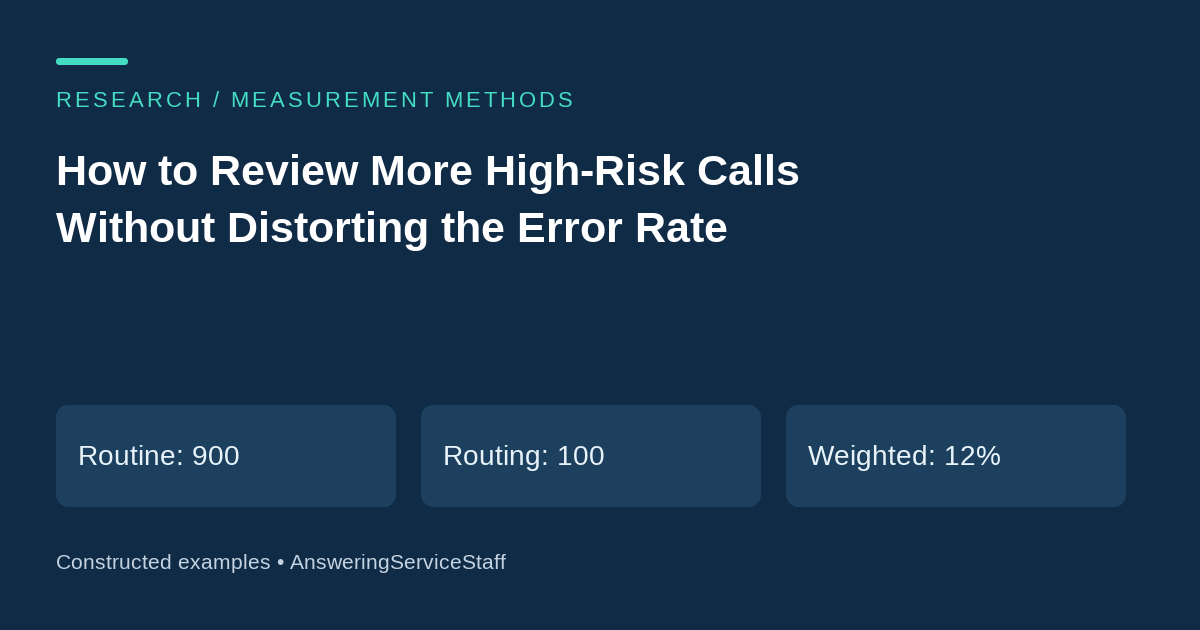
Suppose a month contains 900 routine messages and 100 messages in a predefined higher-risk routing category. The business randomly selects 90 routine messages and 50 higher-risk messages. The sampling fractions are one in ten and one in two, respectively.
The review finds nine defective routine messages and fifteen defective higher-risk messages. The unweighted sample contains 24 defects among 140 reviewed messages, about 17.1 percent. That number describes the reviewed mix. It does not reflect the month's 90-to-10 routine versus higher-risk population mix.
| Group | Eligible population | Randomly reviewed | Defects found | Group estimate |
|---|---|---|---|---|
| Routine | 900 | 90 | 9 | 10 percent |
| Higher-risk routing | 100 | 50 | 15 | 30 percent |
Weight the group estimates by the actual population shares: 0.9 times 10 percent plus 0.1 times 30 percent equals 12 percent. Equivalently, each reviewed routine message represents ten population messages, while each reviewed higher-risk message represents two. The weighted estimated defect count is 90 plus 30, or 120 of 1,000.
The 12 percent result is a sample estimate, not an observed census count. Its uncertainty requires an analysis consistent with the stratified design, including the substantial sampling fraction in the higher-risk group. Applying a simple independent-binomial interval to 140 equally weighted records would ignore the design that produced the estimate.
Define strata without using the review outcome
A useful stratum is identifiable from the eligible inventory before the quality score is known. Examples include an approved escalation route, an after-hours window, or a call type recorded by a consistent process. The classification must be available for every eligible population record, not just the selected sample.
Do not define the higher-risk group as “calls where the reviewer found a problem.” That would use the outcome to determine sampling membership. A complaint flag can define a category if applied consistently and known for the population, but the resulting category describes complaint status rather than an independently assessed risk level.
Categories should be mutually exclusive for the chosen analysis. If an urgent after-hours message belongs to two groups, specify a precedence rule or a cross-classification. Otherwise the population totals and weights can double count the same request. Keep the rule simple enough that another analyst can reconstruct it.
Preserve the selection record
Freeze the eligible list for the reporting period and retain the selection procedure, sample size by group, and selected identifiers. A reproducible random selection can be generated with approved software. The reviewer should not replace a difficult record with a more convenient one without recording the change.
If a selected recording is unavailable, classify it as unavailable evidence and investigate whether missingness differs by group. Substituting the next accessible recording can hide systematic failures in storage or permission handling. The missing record may require a separate process review even if its substantive call quality cannot be scored.
Use coded identifiers and restrict access to the underlying caller details. Sampling documentation normally needs group counts, selection probabilities, and score outcomes rather than complete personal narratives. Preserve only what is necessary to reproduce the measurement under the business's retention and access policy.
Handle unequal review effort honestly
Some calls take much longer to review than others. A ten-minute scheduling conversation and a brief message may consume different review time, but that does not automatically justify counting the longer call as several observations. The unit remains the defined message, request, or conversation.
If the review budget is fixed in hours, estimate how many records can be assessed reliably in each group. Reducing scoring depth solely to achieve a larger sample can create measurement error. A smaller reproducible sample can be more useful than a larger set scored inconsistently.
When a group is very small, reviewing every record may be practical. Its observed group count can then be combined with estimates from sampled groups, using an analysis that recognizes the census component. Report that distinction so readers understand which parts are directly observed and which remain estimated.
Report severity alongside frequency
A population-weighted rate can make a rare but serious defect look numerically small. That is not a reason to omit weighting; it is a reason to report severity separately. Frequency estimates and operational risk prioritization answer different questions.
For example, a rare unauthorized disclosure may demand immediate investigation even if it barely changes the overall percentage. Conversely, frequent minor formatting inconsistencies may justify a template improvement without the same escalation. Establish the severity classification before reviewing results and document ambiguous judgments.
For message taking and routing, report both the population estimate and the specific failure categories that prevent useful handoff. For support intake, distinguish information capture from acceptance by the responsible team. A combined score should not conceal which stage actually failed.
Limits of the proposed design
Weights cannot repair an incomplete population inventory or unreliable scoring. If calls missing from the log are also the calls most likely to fail, an estimate based only on logged calls remains incomplete. Reconcile the review frame to the relevant incoming-call or request totals before treating it as comprehensive.
The method also does not establish that one provider caused a different error rate. Differences in call complexity, client instructions, tools, and review rules may remain. Comparisons require common definitions and compatible populations; a weighted monthly estimate is not automatically a fair vendor league table.
A useful final report names the population, strata, selection fractions, reviewed counts, unavailable records, weighted result, severity findings, and uncertainty method. Keep the targeted investigation results in a separate section. That allows the owner to prioritize difficult calls without accidentally turning a sensible review strategy into a misleading performance claim.
Sources and review date
-
U.S. Census Bureau. SIPP Weighting. Checked November 2, 2026.
-
National Institute of Standards and Technology. Selecting Sample Sizes. Checked November 2, 2026.