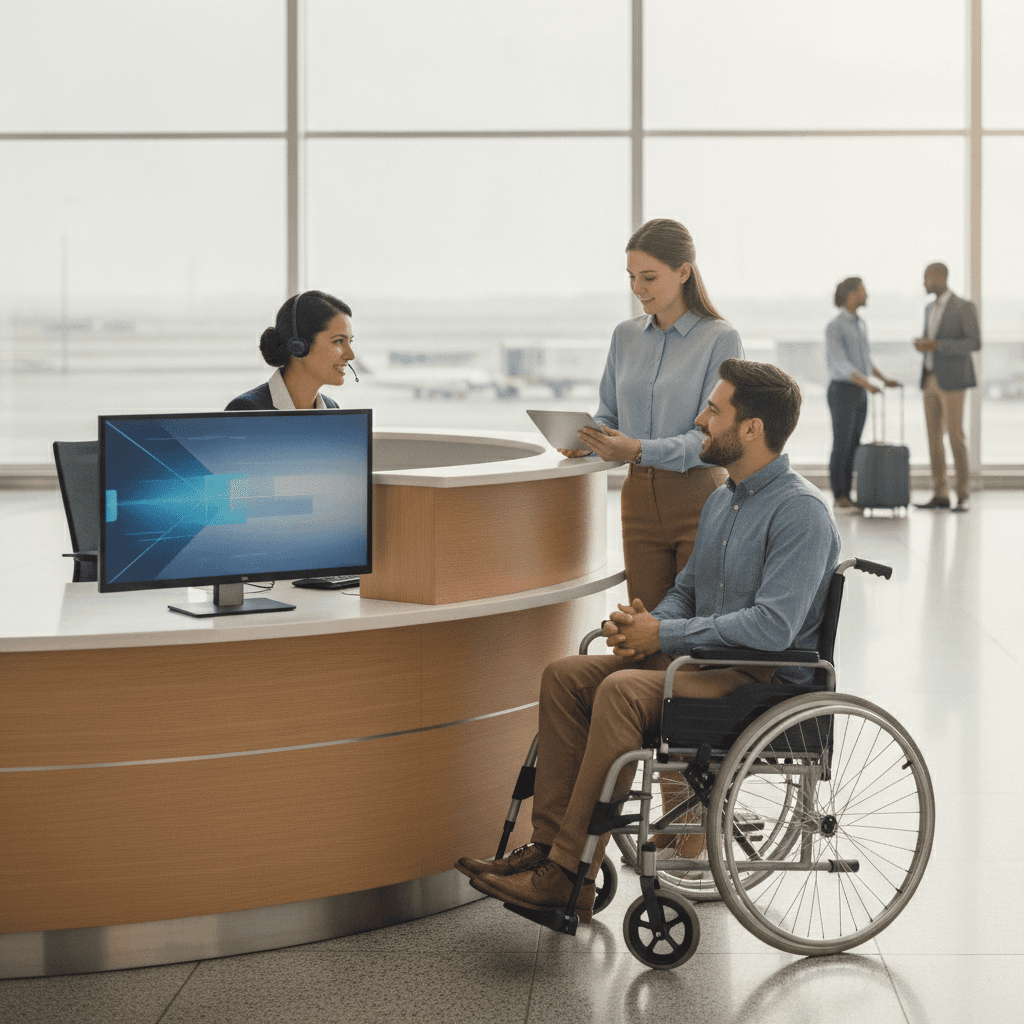
Research question: What information may a live answering team collect during an airline reservation call involving disability-related assistance, and which decisions must remain with the carrier or its trained Complaint Resolution Official?
The evidence supports a narrow answer. A call taker can make the conversation accessible, record the assistance the traveler requests, repeat the request back, and route it to the airline's authorized reservation or accessibility staff. The call taker should not decide whether a person qualifies as disabled, demand medical proof as a routine step, promise a particular aircraft feature, or settle a disability-related dispute. AnsweringServiceStaff can support the intake layer only when the airline supplies current procedures and a direct escalation path.
Method and evidence scope
This review compares the Air Carrier Access Act overview published by the U.S. Department of Transportation, DOT's passenger Bill of Rights, the current text of 14 CFR Part 382, DOT travel guidance, and DOT's complaint channel. These sources describe legal duties and passenger rights. They do not measure the performance of a particular answering service, airline, airport, or contractor.
The distinction between fact and analysis matters here. The regulatory duties below are facts drawn from DOT and the eCFR. The proposed intake fields and routing controls are our operational analysis of how a limited answering role can support those duties without taking over the airline's judgment.
Part 382 applies to U.S. carriers and, for flights to or from the United States, to covered foreign carriers. DOT also states that airlines remain responsible for contractors that provide services to the public. An answering vendor therefore cannot treat accessibility as a message-taking exception. The carrier must define what the vendor may say, what it may record, and who receives a time-sensitive handoff.
What the caller is entitled to communicate
DOT's Bill of Rights groups existing protections into 10 rights. They include dignity and respect, information about services and aircraft capabilities, information in an accessible format, airport and onboard assistance, assistive devices, seating accommodations, accessible aircraft features, and resolution of disability-related issues. A reservation call may touch several of these rights before a ticket is purchased.
The intake task begins with the traveler's own description of the help requested. Useful fields include itinerary or proposed itinerary, contact method, requested assistance, mobility-device type when relevant, device dimensions when the carrier requires them for stowage planning, service-animal questions that the airline authorizes, and any deadline created by imminent travel. The agent should record the caller's words accurately instead of translating them into a diagnosis.
DOT says airlines generally may not require advance notice simply because a passenger with a disability is traveling. Certain services may require notice because the carrier needs preparation time. That difference makes casual promises risky. A call taker may capture when the traveler notified the airline and route the request, but an authorized airline representative must determine which rule applies to the requested service.
A role map for reservation intake
| Call event | Answering role | Required handoff |
|---|---|---|
| Traveler asks for wheelchair or guided assistance | Record the request, itinerary, airport, and preferred contact method | Airline reservation or accessibility desk confirms the service |
| Caller asks whether an aircraft can accommodate a device | Capture device details the airline's script permits | Carrier staff confirm aircraft capability and loading conditions |
| Traveler reports an active denial or disability-related dispute | Preserve the caller's account and time of incident | Complaint Resolution Official or named airline escalation contact |
| Caller needs an accessible communication channel | Use the supported relay or accessible channel without adding barriers | Escalate any channel failure to the airline owner |
| Caller appears to face an immediate medical or safety emergency | Follow the airline's emergency script and direct the caller to emergency help | Emergency services and the carrier, according to the approved protocol |
This map separates documentation from adjudication. An answering agent can ask a neutral clarifying question such as, "What assistance would help you move through the airport?" The agent should not challenge whether the request is necessary or tell the traveler that a service is guaranteed before the carrier confirms it.
Accessible communication is part of the service
An accessible call is not limited to polite wording. The team needs a tested way to accept relay calls, enough time for interpreted or relayed exchanges, and a process that does not disconnect a caller because the cadence differs from an ordinary voice call. Agents also need a way to provide the same trip information available to other callers, within the information and systems the airline has authorized them to use.
The record should distinguish what the caller requested, what the agent stated, what was transferred, and what remains unconfirmed. This protects the traveler from having to repeat a detailed request and protects the airline from treating an intake note as a completed accommodation. A confirmation number or timestamp can help the airline locate the interaction, but it is not proof that every requested service has been approved.
When the Complaint Resolution Official belongs in the route
DOT requires airlines to make a Complaint Resolution Official, commonly called a CRO, available in a timely manner. The CRO is trained to resolve disability-related issues and may be available by phone. This is a defined specialist role, not a label that an answering agent should adopt.
The escalation trigger should be concrete. Examples include a caller reporting that assistance was denied, a disagreement over a mobility device, a disability-related seating problem, or an unresolved question about rights during active travel. The answering script should identify the airline's CRO contact path and a fallback if the transfer fails. A generic promise that "someone will call back" is weak routing for a traveler whose flight may depart soon.
Quality measures that fit the evidence
The regulation does not set a universal answering-service scorecard. Still, a carrier can audit whether the intake layer supports its duties. Useful measures include the share of assistance requests with a complete itinerary, the share routed to the correct airline owner, transfer failures, repeated requests caused by missing notes, and the time between an active dispute call and CRO contact.
Those measures should be read carefully. A high escalation rate may reflect better recognition of protected issues rather than poor call handling. A short call may omit needed detail. Quality review should sample the record and listen for neutral questions, accurate read-back, accessible pacing, and the absence of unauthorized eligibility decisions.
Sources reviewed
- U.S. DOT: About the Air Carrier Access Act
- U.S. DOT: Airline Passengers with Disabilities Bill of Rights
- Electronic Code of Federal Regulations: 14 CFR Part 382
- U.S. DOT: General Travel Tips for Persons with Disabilities
- U.S. DOT: File a Consumer Complaint
Limitations
This review is not legal advice and does not resolve how Part 382 applies to a particular itinerary or event. Aircraft, service, notice, safety, and foreign-carrier details can change the analysis. DOT's Bill of Rights is a summary, while the regulation and current carrier procedures control operational decisions.
The sources also do not prove that outsourced intake improves accessibility. That outcome depends on the airline's systems, training, staffing, relay compatibility, and escalation design. Each carrier should have qualified counsel and accessibility specialists review its scripts and vendor responsibilities.
Evidence-led conclusion
The strongest conclusion is about role clarity. DOT makes the airline responsible for public-facing contractor performance and reserves disability-dispute resolution for trained airline personnel such as the CRO. A live answering team can help by making the first contact usable, capturing the traveler's request faithfully, and moving it to the right owner without delay. It should never turn that support role into a medical screen, a rights determination, or an unverified promise about the trip.